


Das Spaten
(The Shovel)
The shovel was apart of the individual equipment issued to each German soldier was called in slang as 'Spaten'. Worn on the left side of the belt thanks to a leather case, or even canvas for the ersatz versions, the first iteration of the spaten was introduced in 1874 . This shovel has very specific characteristics but its general shape takes up the main features of the models adopted by most armies around the world. Thus, this shovel was identical to the French model except that the diameter of the handle and that of the ball was larger on the German model.
Mads Johan Buch Linnemann was the father of Linnemann style shovel line with the creation of the Den Linnemannske Spade (M.1870) was patented in 1870 and was introduced to the Danish army. Linnemann travelled throughout Europe and presented his invention to various army lines. In Austria-Hungary, a plant was built in Vienna for the construction of his feldspar. By the great war, most countries in Europe was using this base, including the Kaiser Armee.


M. 1874 Spaten
Due to the positive field trials, the German Empire adopted the spaten as of November 1874 on the highest imperial decree for Infantry and Jaeger battalions.
This indispensable tool was made of three metal parts and had a ash wood handle. The shovel head is held together by 5 rivets to the rear part, all completed by a ring with a rivet going through it. It weighed approximately between 0.70 to 0.77 kilograms (1.5-1.7 pounds) and made from hardened cast steel sheet.


M1882 Pioneer Spaten
Like all materials, this tool was produced in a simplified version; it must be said that the production of a wooden handle is a stage that takes time, not to mention the assembly that must be done afterwards. Thus, an ersatz model made entirely of iron was developed.


M. 1898 Spaten
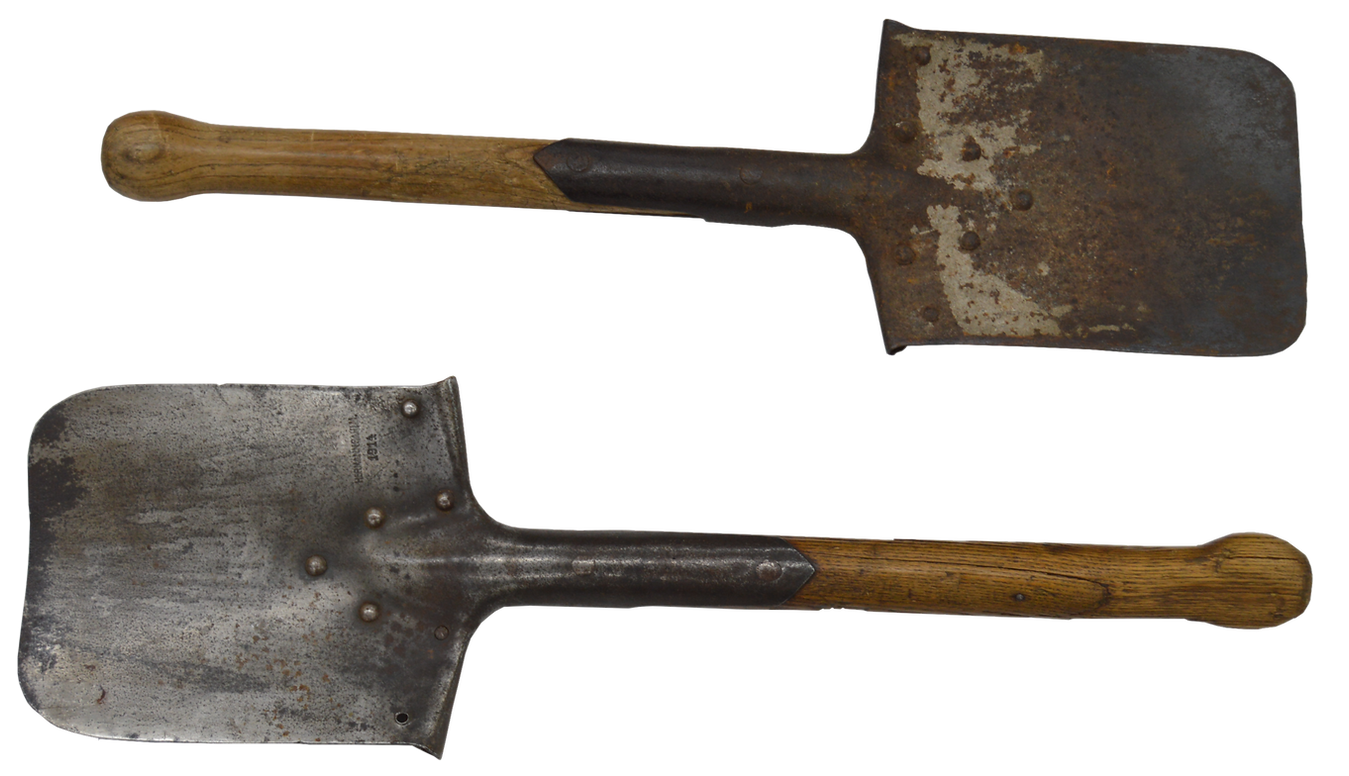
In 1898 (M98) the next spade model appeared, which had an amplified kick edge as the main difference, which was riveted to the left and right of the spade leaf. Instead of the metal ring, which had previously held the grommet together additionally, this task was now taken over by a work piece cut from a sheet of steel. In the area of the grommet, this sheet was secured by a riveting point on the wooden shaft of the handle, as in the original ring. The rivet head was executed at this point and at the rivet site of the grommet of the spout on the model 98 flattened on the model 98, since the semi-round rivet heads could scrub while marching on the man.
It will be necessary to wait for the year 1898 to see appearing another model of shovel. Indeed, this new Spaten (the most common model) is easily recognizable since its edges, which are now original folded, are riveted! The riveted 'dog ears' were speculated to allow the user to apply greater force on the spaten when digging. In addition, this shovel is now made in two parts (one of its parts acting as a ring) while its thinner handle has a smaller ball, even ovoid, as on the French model.

A M.98 spaten is seen on the hip of this German Soldaten of the 110th Regiment.

M. 1901 M.G. Spaten
Machine Gunners Spade Model 1901 (MG Spaten 01). From 1901, MG troops were equipped with the slightly smaller and shorter spade. The handle is obviously shorter, but also the blade is slightly smaller than the infantry version: overall length about 18cm, overall socket length 11cm, socket diameter about 2.8cm, and the max width of the triangular reinforcement/support is about 7.5cm. MG 1901 are usually always maker marked unlike the infantry shovel. They also had their own special leather carrier with a single loop for the bayonet.


M. 1916 Spaten
Like all materials, this tool was produced in a simplified version; it must be said that the production of a wooden handle is a stage that takes time, not to mention the assembly that must be done afterwards. Thus, an ersatz model made entirely of iron was developed.
The handle for these were hollow as an attempt to reduce the weight. However, this lead to three issues. An all iron handle reverberates every scrap, ding, jab, and texture up the shaft and into your hands, there is a reason why wood is desirable. The second reason is because the hollow shovel will bend as well. There was once a story I had read that spoke of a French Man in Verdun coming across a crater of all steel German shovels that had been discarded and thrown into the crater, all the handles bent.
The final issue was, the shovel was slightly heavier than the earlier renditions, and thus added to the discomfort of the soldiers fighting at the front, and thus earning their ire.
Due to the reasons above, many of the shovels were indeed discarded, and thus finding these unusual innovations of war is difficult to find. But not exceptionally rare. The two samples shown below is steel and painted variants.


Fun Spaten Facts!
-
During the First World War, all three models were used and – sharply honed – to a feared weapon in the trench war man against man. Since, unlike the other countries, the British did not have a handy feldspar, but used a construction that had to be composed first and was a mixture of pickaxe and feldspars, German feldspars were a popular loot weapon.
-
There is evidence that the spaten was painted feldgrau and gray during the war, however not wide spread. The paint was intended to prevent rust from forming, however, when digging the paint would scrape off!
I have seen very few intact painted samples. Some times you will find fragments and occasionally a photo of a soldaten with a painted spaten!
Spatentasche
(short shovel carrier)
M1887 Carrier
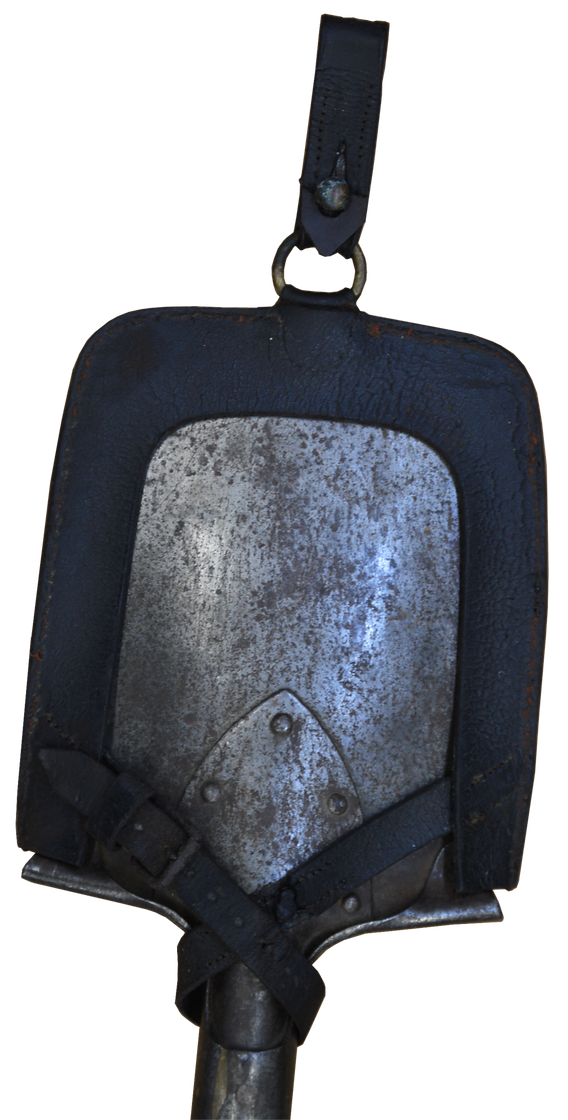
On 3rd of March 1887 with the introduction of a new Infantry Tornister, the infantrie model shovel was to be attached to the belt behind the bayonet. For this purpose, a leather case would be looped to the belt. On that note, the M87 is distinguished most by the singular loop that had a stud to hold the loop 'shut'. These were issued in black leather with some that can be found with maker marks along the top of the leather carrier to have marker marks, depot marks, or event regimental information.
Note: I would be remiss if I didn't mention that there would inspire an exported model sent to Argentina that had a noticeably longer loop.
These were eventually replaced by the two looped model 1909 leather carrier due to retaining issues. However, it should be noted that in 1914 there were still regiments that marched to war with these, while other rear line units were given these carriers to free up the more 'modern' variant for front line use.
These are considered very rare.
General Measurements:
28cm tall entirely (approx.)
16.2cm wide
3.2wide Ring
Loop:
2.1wide belt loop
22.7cm full length (including fold over with rivet)


M.1901 MG Shovel Carrier
A studio photo of a German Soldaten wearing a 1901 MG Spaten.


This one is marked 'Awdr 16' which means it was made by Artillerie Werkstätten Dresden (Saxony) 1916.
M1909 Carrier
By the 26th of June 1909, the new model carrier was introduced as a means of greater security to the shovel. It would fasten to the belt, one loop on each side of the bayonet and frog. The leather loops and straps were sewn into the leather frame. Maker marks were typically seen between the loops or on the 'cross leather' on the back side of the carrier. Sometimes you would find arsenal and/or depot markings on them, and even Regimental markings!
The leather coloration for these were brown or a reddish brown. There were some units that were issued black leather carriers at the start. However, keep in mind that as the Great War happened, it would not only be blackened, but the carriers under went their own evolution.
1909-1915
Production

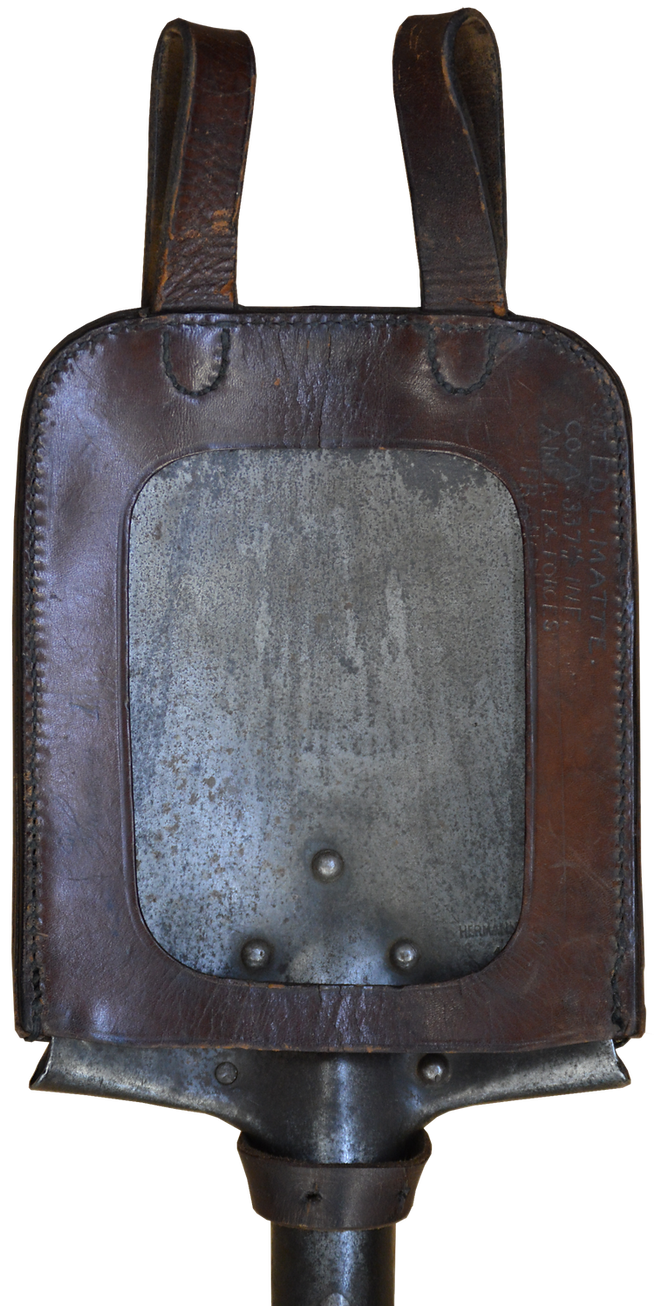

The loops were sewn into the carrier up until 1916, when the leather loops were then attached to the exterior

A M09/16 carrier with a Seitengewehr 88/98 and M16 Bereitschaftsbüchsen.